
Event date: August 26, 2026. Workato, 600 Illinois Street, San Francisco.
It was Wednesday last week, right after some intense deep dives into threat hunt harness that we released in Vigil SOC 0.5.0, I took the Caltrain to The City (For non-bay residents, It's San Francisco). I was MCing this edition of AI Cyber Alliance being held at Workato. This was my second time hosting an event for AI Cyber Alliance. Every event is different, new faces in the audience, new ideas and new conversations. I absolutely love it.
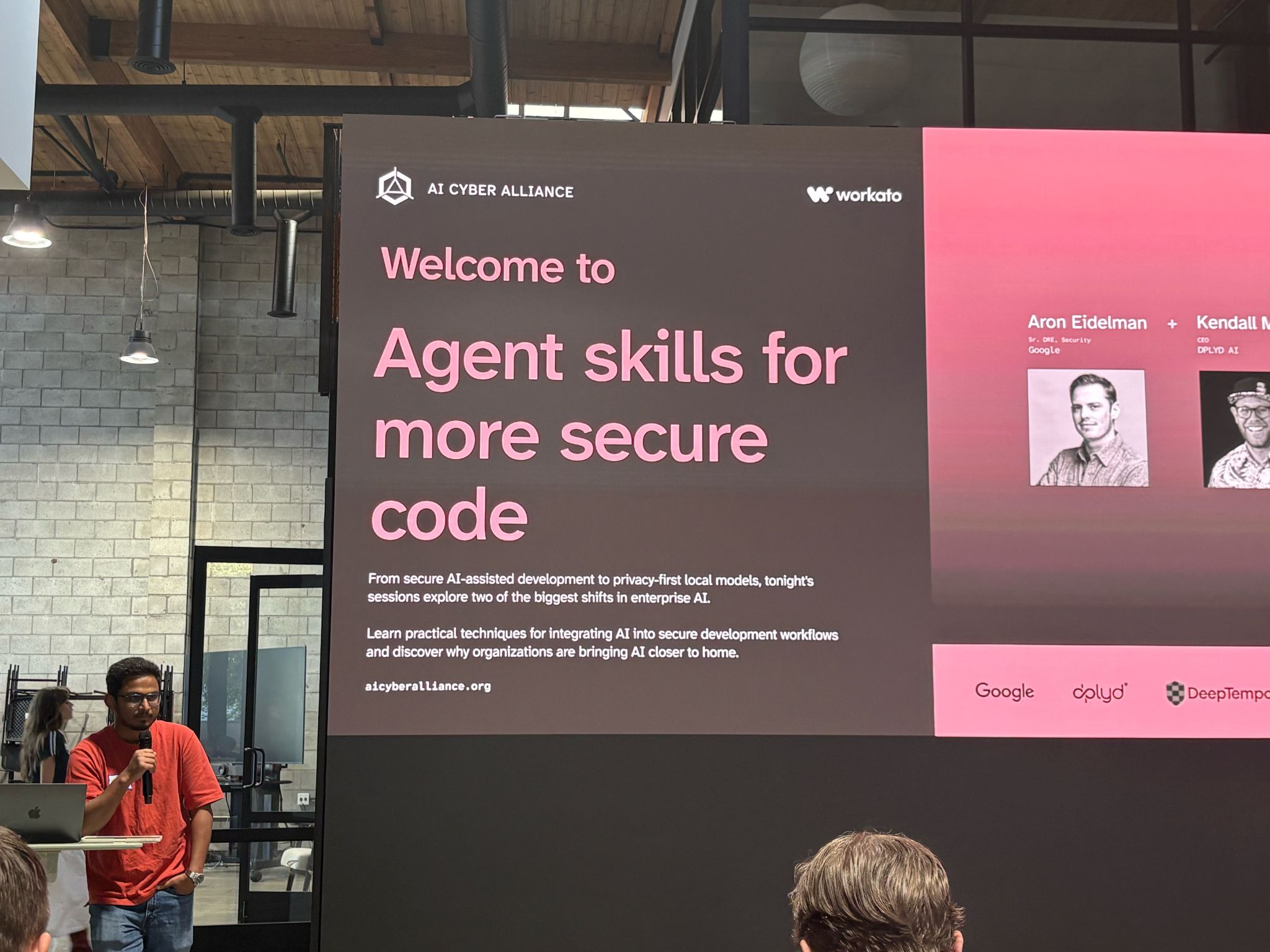
This energy of the audience defines the Bay Area. People are always excited about the next big thing, learning and seeking options to create value. As I settled down, finished the sound check, folks started filling up the folding chairs, food, drinks and exchange of ideas and networking started happening.
When DeepTempo started AI Cyber Alliance this Spring, the goal was simple: create an event that is built for practitioners by the practitioners. We get a mix of audience, developers, security engineers, founders, AI engineers, students and more. And that is the spirit of the event. Bring people together to share their latest finding, in one of the events our speaker jailbroke an LLM live in front of the audience.
This event on 26th Aug was no different, we had two phenomenal speakers talking about two pressing issues of current times, securing code and why we need local AI.
Our first speaker was Aron Eidelman who is Senior Developer Relations Engineer for security at Google. He is an international speaker and has spoken at global events like AWS Re:Invent, Google Cloud Next, BSIDES and more. He opens with a banger - the Vulnpocalypse. AI raises the code throughput and vulnerability discovery at the same time, and the second half is the problem. Automated sweeps flood the queue with more findings than anyone can triage. Attackers reverse engineer updates and weaponize them in minutes. Meanwhile triage and patching at the pipeline level pushes remediation by 20 to 70 days. At this scale, reactive mass scanning becomes a dated approach. It fails not because it is built badly but because the input rate has changed.
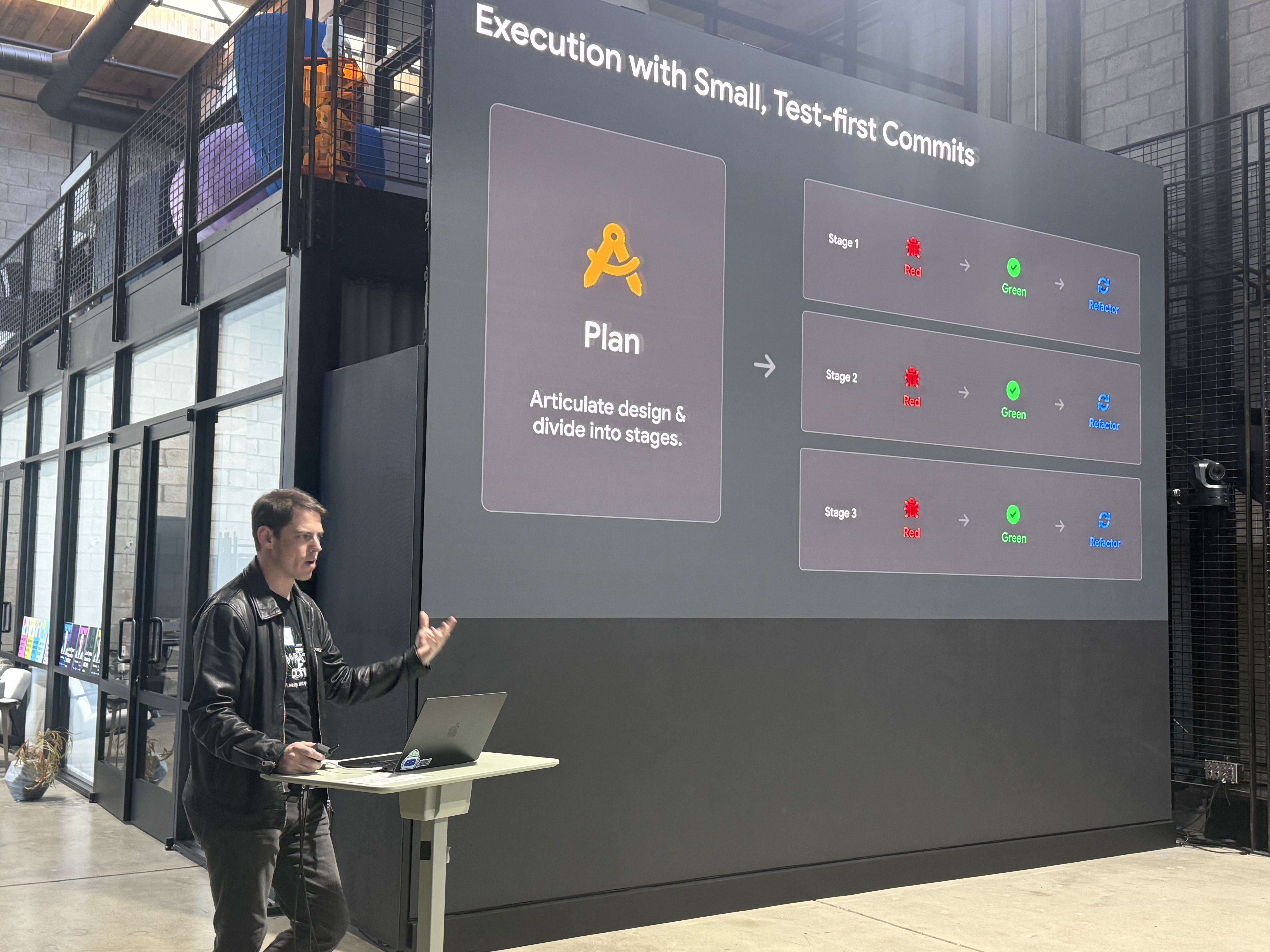
His answer was very practical, shift left and shift down to the coding agent itself, since the agent is already doing design, build and test. The practical core: plan first, articulate the design, divide it into the stages, then execute in small test-first commits. Add pre-commit scanning and hooks for the problems AI coding is making worse, and make the skills reusable so the next repo starts from the same baseline. Fundamental principles remain the same, something pre-commit hooks were doing for code quality, detect and correct. Aron shared skills he created for threat modelling, test-driven development, secure coding and the hook for `git push` auto fixes vulnerabilities and high severity findings. And it ports across any coding agents like Antigravity, Claude Code and more.
As agentic coding, or as Andrej Karpathy called it "vibe coding," became the way most people write software now, this was a wonderful reminder and a usable guide for how developers can keep security inside the loop instead of behind it.
With that we moved to the second topic of the day, a talk by Kendall Miller titled Local AI, Why Now?
Kendall is working on DPLYD, a simple way to run local AI models for regulated industries and privacy-conscious teams. I was already sold when he said that he also makes whiskey and he subtitled his talk, “A Song of Ice and Doom” - this joke didn’t land during the event but I really hope it does now. Anyways, in the world where enterprises are increasingly cautious about data privacy and security, this was hitting all the right notes.
.jpg)
He brings in this interesting analogy of how refrigerators become household things, similarly tools to deploy and manage local AI are making their way towards becoming refrigerators of the AI world. In 1900, ice was the ninth largest industry in America: harvested ice, cut from frozen northern lakes and shipped south. By 1914 the lines crossed, 24 tons of manufactured ice against 26 tons harvested. Over that stretch the price fell from six cents to half a cent, roughly twelve times cheaper. Manufactured ice did not win on quality. It won because producing locally got cheaper than shipping centrally, and once that flipped, the incumbent industry had nothing left to defend.
Similarly, open-weights models keep improving, consumer hardware keeps getting more capable, and the same crossover is arriving for inference. He left the audience with a tool for their personal, local AI needs - LLMFIT. It is a terminal tool that scored 148 models against the 16GB M1 sitting in front of him: tokens per second, quantization, memory footprint, context window, and a plain verdict on whether it fits. Essentially helping users to answer: what can I actually run on my machine?
An important shift especially for anyone in legal, healthcare, defense or any environment where data cannot leave the building, running AI locally matters more than leaderboard.
Security is critical in current AI adoption
As I mentioned above, agent-driven coding is becoming the mainstream way software gets written, which moves the question from whether to use it to who checks what is committed. Manual or old reactive scanning is not feasible anymore. And while you code, you are definitely using models in environments where you don’t want to share the data for example, defense use cases, your personal AI needs. In both the talks it was evident that to drive AI adoption, security must be a first class citizen. Not only to safeguard your data but also to safeguard your environment from AI-powered attacks.
From Developers, For Developers
The AI Cyber Alliance runs across the USA including the Bay Area, New York, Boston, Austin - next week! - and more.
Aron’s config is public and available at this github (github.com/h3xar0n/secure-coding-agy-config) and it is worth reading the threat model he wrote for the hook itself. In the same spirit, developers at DeepTempo have also released open-source projects, VigilSOC (https://github.com/Vigil-SOC/vigil) and SOCBench (https://github.com/DeepTempo/socbench). I would love to review your PR.
We are always looking for speakers. If you have something you are building, breaking or arguing about, I would love to hear from you. Support of any kind, venues, sponsorship, or just bringing a colleague keeps the momentum going and I will really appreciate your community spirit in adding fuel to the fire. You can reach out directly via https://ai-cyber-alliance.org/ or hit me on LinkedIn, https://www.linkedin.com/in/krmayankb/
This post will be incomplete without thanking our event sponsor Workato (https://www.workato.com/) for hosting us at 600 Illinois, and to Leila Rishniw for organizing the event. Also, to our speakers, Aron and Kendall for sharing those insights to our audience and for the more than 100 people that registered and the rather fewer that actually made it to the event.
We will be organizing more of these in the bay area, including several at the Menlo Park SVAI HUB started by Snowflake. Please stay tuned and stay in touch. I look forward to seeing you there.
