
Teams increasingly deploy Vigil both to deliver use cases such as threat hunts, investigations and detection engineering, and to serve as the System of Learning for their cyber deployments, where verdicts, context and controls accumulate. Vigil appears to be the first AI SOC that supports a GUI, a console such as Claude Code, and true headless operation via agents, including third-party agents like CrowdStrike's Charlotte.
The community has already started connecting agents from other platforms, including CrowdStrike's Charlotte, to Vigil over MCP. The learning and the controls stay on premises in Vigil, while CrowdStrike users work in the interface they already know. Teams can scale their use of AI, safely, without leaving the systems they know and while increasing their controls over their cyber.
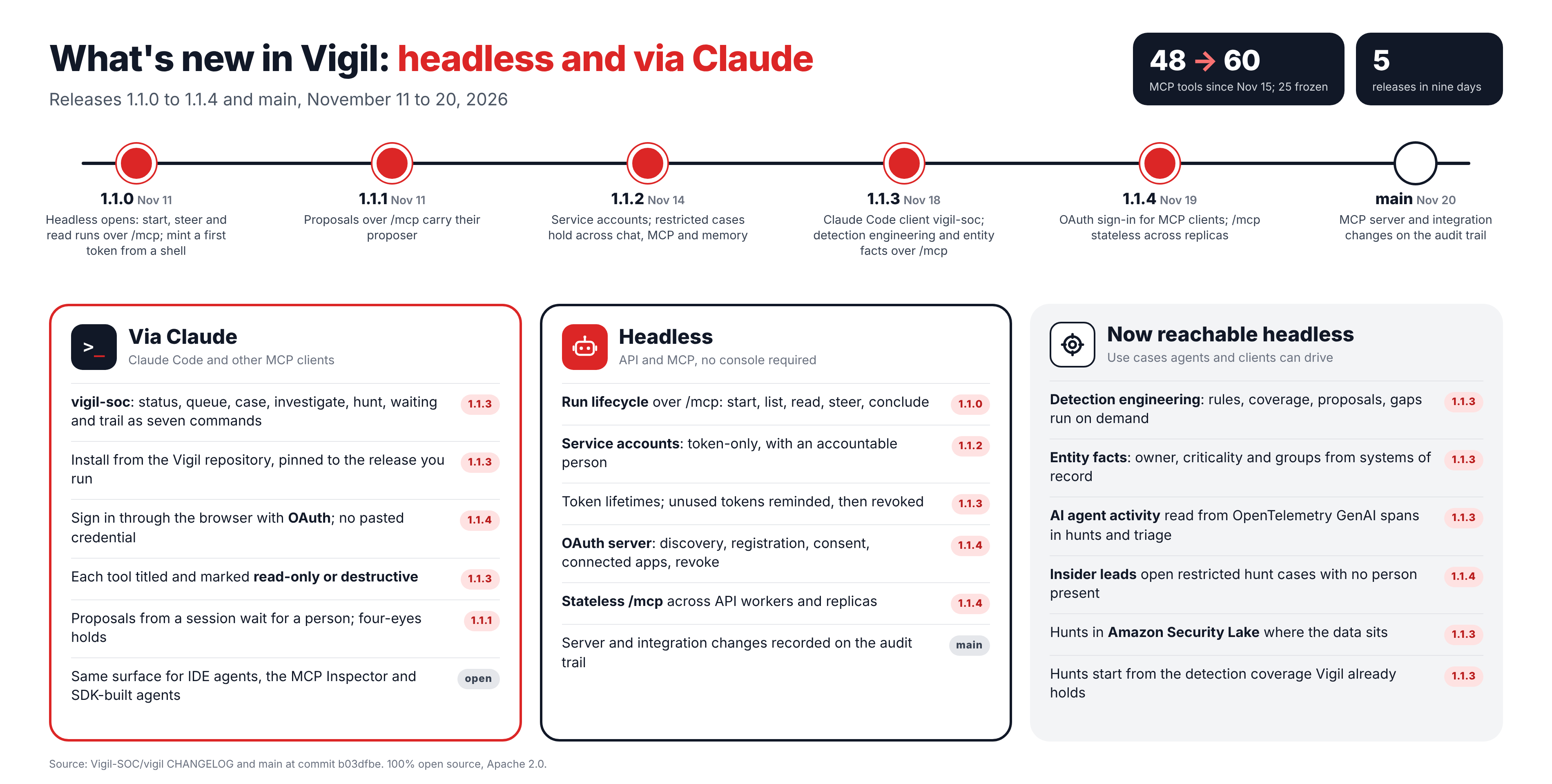
In many cases the client is Claude Code, so below I set out that approach in a bit more detail, with a schematic. You can operate the 100% open source Vigil through its API and MCP surface and never open the console. This week we shipped a Claude Code client, the first outside client we built for that surface. You can now work your own Vigil from a Claude Code session, from other MCP clients, or through agents that never touch a screen.
If you prefer the console, nothing changes; it remains a first-class way to run Vigil.
Courses and Horses
Each method of leveraging Vigil works against the same System of Learning: the same skills, the same ledger of verdicts, the same memory, under the same scoped access and audit trail.

Headless means more than a terminal. An agent working under a service account holds its own token and an accountable person, so it can start hunts, read conclusions and record evidence on a schedule, within the role you grant it.
Your team can watch those runs through the OpenTelemetry traces and metrics Vigil exports, from the dashboards it already keeps. We hold the API and MCP surface steady and freeze the tools that mirror frozen API operations, so clients can come and go.
Install
Two commands install the client from the Vigil repository on GitHub. Pin the tag to the version of Vigil you run:
claude plugin marketplace add Vigil-SOC/vigil@v1.1.4 --sparse .claude-plugin clients/claude-code
claude plugin install vigil-soc@vigil
Yes, the first command says "marketplace." Claude Code uses that word for any repository that carries a plugin catalog. Here it means the Vigil repository and nothing more.
Claude Code then asks for two values: the address of your Vigil and a credential you mint in it. That completes the setup. If your operator has turned on OAuth for the surface, you can sign in from your browser instead of pasting a credential. The README covers both paths.
Work
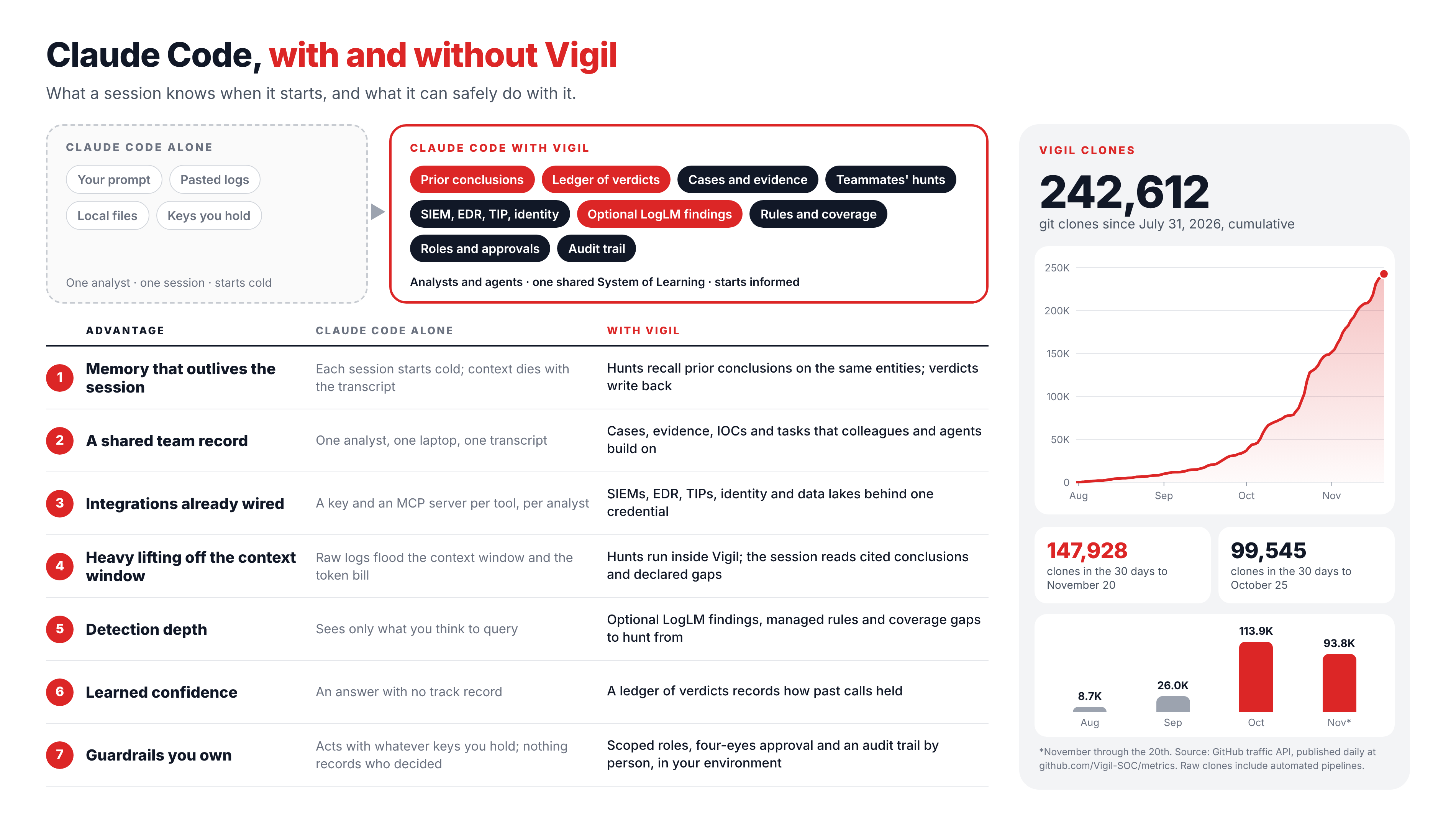
Claude Code is amazing and many users don't want to shift context. Now with Vigil running as a Claude Code plug-in, they don't have to. This does raise the question in some minds: why Vigil? What again does Vigil do that Claude and Claude Code alone cannot do?
The short answer is that Claude holds no cases, no record of last week's hunt, and no view of what your colleague concluded yesterday. Your Vigil has this context, and you reach it with seven short commands:
- /vigil-soc:status checks that your Vigil answers for your credential.
- /vigil-soc:queue lists open findings and cases.
- /vigil-soc:case opens one case with its evidence.
- /vigil-soc:investigate and /vigil-soc:hunt start a run in Vigil. You steer it from the session and read its conclusion, with citations and declared gaps.
- /vigil-soc:waiting shows what awaits a person.
- /vigil-soc:trail reads the audit trail.
Vigil's agents do the work, through the integrations you have already connected, and under the controls and decisions on model selection that you have made for each activity.
Collaboration
The SOC leaders we have chatted with that use Vigil not surprisingly care about the effectiveness of their teams working together.
Now this collaboration can be boosted, while allowing users to stay within their own Claude Code. Each analyst retains their own credential. A colleague opens the same case from their own session, reads your verdict, and builds on it. A new run begins with what earlier runs concluded about the same entities, whoever started them, analyst or agent.
That shared record is the learning loop. With it, defenders turn the OODA loop faster than an AI attacker can. As I argued in Systems of Record vs. Systems of Learning, the post in which I coined the term "System of Learning", with proper focus these systems directly deliver competitive advantage to organizations.
Control
Control is of course central to the value proposition of Vigil. Each call runs under the caller's own role and lands on the audit trail under that person's name. From a session, an analyst can propose an action but cannot approve it. A person with approval rights approves it, and with four-eyes controls on, that person cannot be the one who proposed it.
Boundary
We built the Claude client to talk only to your Vigil. Neither DeepTempo nor the Vigil project receives anything from it, and it carries no telemetry. Route Claude Code to a model inside your own environment and the data stays there. Our privacy page spells this out.
One limit: the connection works in Claude Code, meaning the terminal, the IDE extensions and the Code tab of the Claude desktop app. However, in the Claude chat app the commands load but cannot reach your Vigil, because chat connects only to servers at a public address, and most teams do everything they can to make sure their deployment of Vigil is not publicly accessible.
Clients
Any MCP client can work the same surface: an IDE agent, the MCP Inspector, or an agent your team writes with an MCP SDK. When your operator has turned on OAuth, desktop and command-line clients sign in through the browser with no extra setup; scripts and service accounts present a token.
LogLM
LogLM, DeepTempo's foundation model for detecting AI-powered attacks in security telemetry, remains optional. Run it, and its findings join the same queue, where you or your agents can hunt from them. This helps across many use cases, ranging from detection engineering through threat hunting and more.
Future
Agents are becoming the primary users of enterprise IT. Consoles and clients, including Vigil's increasingly beautiful GUI, will come and go. The underlying contracts will endure: the API and MCP surface, the data layer, and a learning loop you own and run in your own environment. Claude Code is the first outside client we ship for that contract. Build the next one and tell us about it.
As far as we can tell, Vigil is the first AI SOC that you run in your own environment and supports Claude Code as a first-class console. We publish all of it under Apache 2.0. Clone it, try the client, and tell us where you'd like us to go next. The Vigil community development velocity seems to be unmatched. Open innovation, powered in part by the DeepTempo-funded Vigil factory, is a better method of building and delivering the software we need to outcompete the adversaries, together.
Try the 100 percent open source Vigil SOC today.
